Dreams...
It may be a dream afraid of waking up, or it may be a dream coming to realization in the next morning.

Saturday, December 4, 2010

Movie Review 4 - Welcome

"Welcome" is a foreign movie about an Iraqi-Kurdish young man, Bilal Kayani (Firat Ayverdi) who was determined to travel across the world just to see the love of his life, Mina (Derya Ayverdi), in the United Kingdom. Bilal was very determined that he actually could make a risky decision by migrating illegally to France, because that was the point he could go from to see Mina. After getting to France with some legal and court struggles, he began to realize that going to the United Kingdom might be trickier than he initially thought. He had to swim across English Channel, a wide ocean that connected France to the United Kingdom.


Bilal didn't know how to swim, so he registered for two swimming class with a French instructor, Simon Calmat (Vincent Lindon), but the latter could smell what Bilal's agenda was to learn how to swim. Still teaching how to swim, Simon was beginning to form a bond with his student, from where he learnt that Bilal's motive was to reunite with Mina. Feeling emphatic towards the young man since he was about to go through a divorce process himself, Simon aided Bilal's efforts and helped more than just that, he even gave temporary shelters. In France, there was this law that prohibited the local people from helping the illegal immigrants in any ways, because it would reinforce the latter to keep coming to the country. However, Simon couldn't care less and kept sheltering Bilal, taught him how to swim, and even generously gave him a swimming suit and a ring from his ex-wife so Bilal could present it to Mina.


Simon was in a lot of troubles because of that. He even was jailed because of his insistence that there was nothing wrong with helping illegal immigrants with a place to sleep, though he initially lied about that. Simon's ex-wife even warned him that what he did might be very kind, but was not worth it because it could cause a lot of problems. But Simon deafened his ears, until when reality struck, when Bilal really did decide to swim across English Channel. Panicking over his safety, Simon called the coast guards to save him. Bilal was brokenhearted when his attempt failed, and decided to go for a second time, and this time, he said to himself, he'd make it, especially when Mina called to rush him over because her father was arranging a marriage for her.


The second time did not side on Bilal. Unfortunately, the guards from the United Kingdom noticed a human figure floating around in the sea and wanted to catch him. Bilal panicked and he tried hard to hide from them, by diving into the water. However, his own determination killed him when the guards realized that the figure did not come back to the surface. Simon was called by the authority to be informed that Bilal died. Simon came to the United Kingdom by himself to give the ring to Mina, and to inform Mina that her love died while crossing the water.


Love can make us blind. And not just that, it can make us do brave and risky and, well, stupid things. But this movie teaches us about something. It teaches us the value of determination. It teaches us the value of never giving up. Even if Bilal didn't make it to see his girlfriend, but his efforts were so valuable that Simon was touched by them and decided to make it forever and memorable by giving the ring to the girl. If Bilal didn't risk his life illegally migrating to France, didn't have the guts to ask Simon to be his teacher, didn't have the courage to swim across a wide sea, none of it would happen. 


Simon said, "the boy could swim to meet his girl, but I can't cross the road to get you," referring to his regret over having to divorce his wife, whom he was still in love with. It's true, sometimes it's as small as a simple road, or as massive as a huge ocean, but it all comes down to our own perception whether or not we want to start taking our first step, and go on and go on and go on. Kelly Clarkson sang in her single "Breakaway," that she'll spread her wings and she'll learn how to fly, and she'll do what it takes until she touches the sky. So, my message to everyone and me too, do what it takes until we have a grasp of what we want to achieve, until we touch the sky.


"It's better to die fighting than to live in fear..."

Friday, December 3, 2010

Movie Review 3 - My Name Is Khan

The idea and debate about Islam and terrorism have been incessantly ongoing, especially after the tragedy of September 11, where Muslims were the targets of blames. Rizwan Khan (Shah Rukh Khan) was not an exception. After marrying Mandira (Kajol), Rizwan lived his life as a married man with Asperger's syndromes happily, because his wife and his stepson accepted him for who he was. All the wonders ended when the towers in New York were attacked by militant extremists, and Rizwan's life started going downhill. When the son of the family, Sameer, got killed because of his recent change of last name to 'Khan,' Mandira began to feel that marrying Rizwan was the biggest mistake of her life. A sobbing scene at the boy's murder place, Mandira pecked that if she didn't marry him, nothing would turn out like this and swore that she'd never accept her husband back in her life until he went to the president of the US and said, "My name is Khan, and I'm not a terrorist." Rizwan, being autistic, took it literally.

Rizwan, then, swore off that he'd never return to the lap of his wife until he did what she asked him to do, leading him to a series of terrorism-suspicion related events, such as being investigated in the airport, witnessing an Indian hotel being thrown with a rock, and being looked at prejudicially when he perform Islamic prayer in the public. But nothing compared to what happened when he finally got to meet the president, but being arrested after yelling, "I'm not a terrorist! I'm not a terrorist!", and people, having the tendency of negativity bias, only focused on the last word of his sentence.

He was put in jail, being beaten up by an inspector, and frozen just because he was thought of having the information on some terrorist groups. However, destiny sided on him when two dedicated journalists actually recorded everything when Rizwan cried the "I'm not a terrorist" and it could be a proof that Rizwan was actually not. Trying to find an agency who could make a story about Rizwan, the journalists were finally helped by a scared Sikh journalist, who opened the eyes of the American authority that Rizwan was not a terrorist.

Rizwan journey turned from religious to humanity issue when he met a poor family in a poor town, Wilhemina. When flood struck the town, Rizwan was the first one to help the people in the town build back what had been damaged, inspiring many people in the country to come and lend a hand. After an eye-opening revelation, Rizwan finally got to meet the president and tell him what Mandira had inadvertently implanted in her husband's mind. The both finally got back together.


This is, for me, a very good representation of how Islam and Muslims have been perceived since the tragedy in September, which actually still goes on until now. Some people in this world are still terrified whenever they hear the name Islam. What pops into their mind when this religion is mentioned is bomb, explosion, or murder. Luckily, a lot of sides of people now realize the true nature of Islam and start to advocate for it.

As how this movie has shown, the perception of Islam and how it goes on from teasing, to insulting, to unnecessary war, has been an issue of religion turning to an issue of humanity. Looking at how people in Palestine suffer, not just the militants, but the public, as in the women, and the old people, and children. I do not want to blame anyone, but a war that does not follow ethical guidelines will never turn out good. A war that is based on generalization of the perception of a small bad group to the people in general is always disastrous.

Rizwan Khan was just another Muslim, suffering from the prejudice that stemmed out from this kind of generalization, and this kind of war. There are other Muslims just like Rizwan, with or without the Asperger's syndromes, who might be suffering from the same too. It's important that the people are educated about issues like this, because illiteracy is what actually starts out prejudice that can result in many other hazardous events, like war. Educate yourself, and when you're capable, try to educate others. Hope this condition might better soon.

Thursday, December 2, 2010

Movie Review 2 - The Experiment

Have you guys heard of a classic unethical experiment called as the Stanford Prison Experiment? This field experiment sought out to see the attribution to the behaviors manifested by guards and prisoners in a prison that lead to abusive treatments. This is the base of this 2010 thriller movie, "The Experiment" where chosen male participants would be acting as the guards and the prisoners in a mock prison. Much of the motivation these guys decided to participate in the first place was the handsome amount of money offered if the experiment was successful, about $1000 perday, and the experiment was intended to go on for two weeks.

Travis (Adrien Brody) and Barris (Forest Whitaker) were basically the main pro- and antagonist of the movie. Travis was located among the prisoners and the Barris among the guards. The first day went on normally, with ever participant still adjusted to the role that had been given to each one of them. However, as the days went by, they started to take their role seriously, actually too seriously.

Travis quickly became the unofficial leader of the inmates since he was with all the courage and bravery to protest, and Barris quickly assumed as the leader of the guards when his initiatives to shut down Travis' rebellion was respected by the prisoners and the guards altogether. However, being too deeply invested in his role, Barris started to act authoritarian, where every rule, or his rule, broken would be responded with aggression until it flamed a serious anger when Barris killed a diabetic inmate, who also was a friend of Travis'. Starting from there, and the drowning-of-head-in-the-toilet-bowl, the prisoners, led by Travis, became uncontrollable and ran amok to take down of the violent guards. Until when it was too aggressive, the  participants were finally let go, and the experimenter was arrested for manslaughter.


A lot of psychological phenomena can be observed from this movie. First, role theory asserts that every individual carries a set of roles within him or her. Somehow, when we're given a role, we're more likely to conform to it, because there are a certain expectations that we do not want to violate (like not wanting to mess up their role as prisoners and guards because they're expected to finish the experiment or else, they wouldn't get paid). These roles, and the way we try to uphold them, influence our behaviors and personality traits. This might be why Barris who was a shy and homebody man, became very aggressive and violent once he was very uptight about his role as a guard.

Second, do you remember Stanley Milgram's obedience experiment? He found from his experiment that people have the tendency to obey to an authoritative figure to a frightening and threatening level, up to the willingness to end a life. The experimenter in "The Experiment" and in the original Stanford Prison Experiment (the experimenter acted as the superintendent) became the authority and the guards obeyed to them. Without the guards realizing, a man died and bloods were spilled. That is how dangerous obedience can be.

Third, you can see from this experiment how Maslow's Hierarchy of Needs can be seen very significantly. The prisoners were secured with the biological needs, but their safety need was the one that was threatened. You can see how true it is that we could go to an unexpected length to make sure that we're safe. When the prisoners in the Stanford experiment felt unsafe with the guards taking control, they started to rebel, and in the movie, the rebellion caused a bloody war.

This movie, although only partly represented the experiment, actually gave good ideas how dangerous a certain psychological phenomenon can be. Which is why some experiments are unethical in the first place, because lives could be at stake. Watch it if you're a fan of psychology. This might inspire you.

Wednesday, December 1, 2010

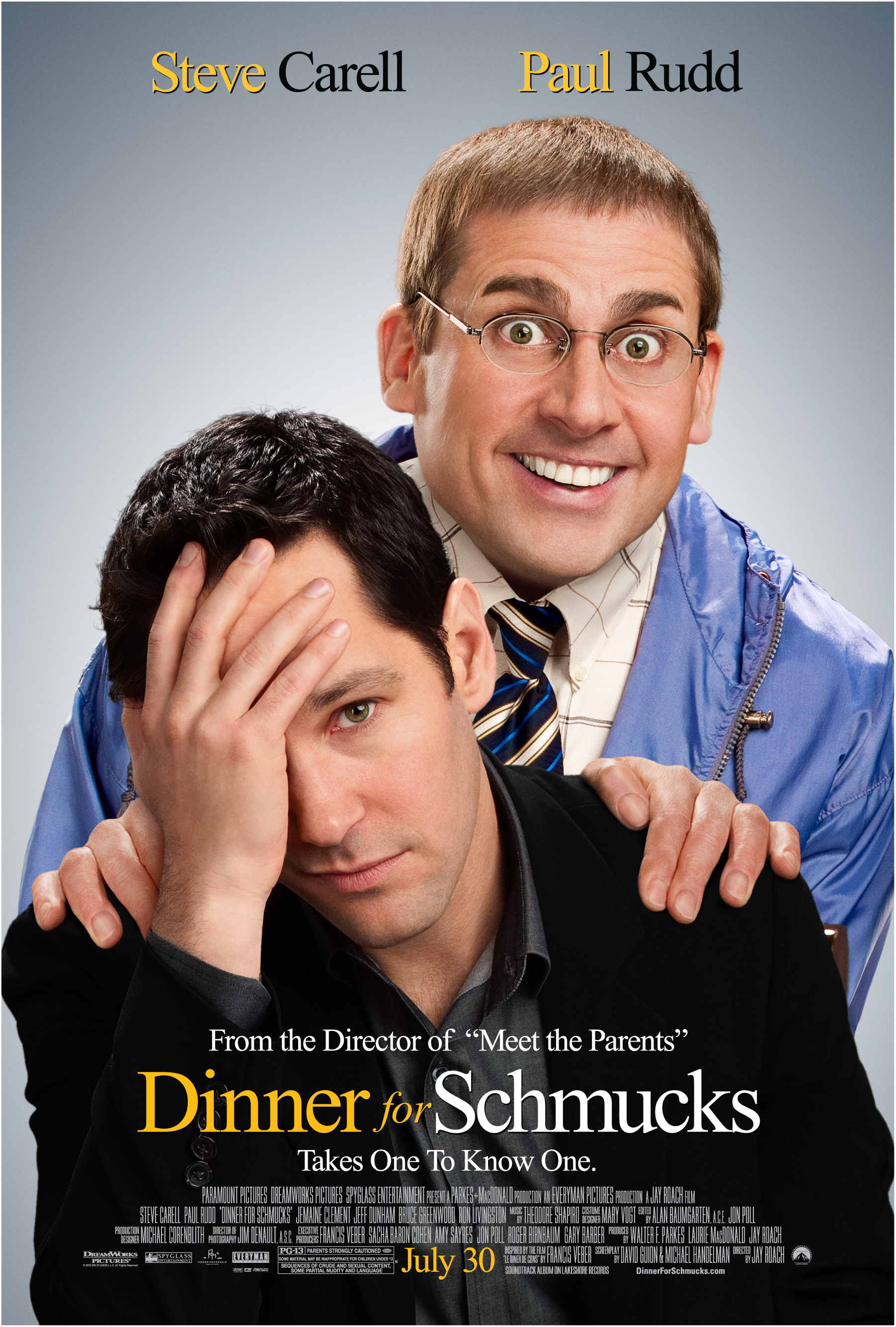
Movie Review 1 - Dinner for Schmucks

This month December, I will dedicate my blog posts to reviewing movies I missed before, that I'm catching up now, and I feel it's worth it to be reviewed. Maybe the movie has some good qualities, and is worth to watch. The first review will be Dinner for Schmucks. I know, I know, this movie has been ages but deep down I really feel like I need to watch it, and it seemed like I made the right choice.

Dinner for Schmucks is about how an employee was trying hard to impress his boss to get promoted, was in a dilemma when he was invited to a dinner where every guest should bring an "idiot" for them to make fun at. Tim (Paul Rudd) found Barry (Steve Carell) trying to save a dead mouse on the street, and texting while driving, Tim bumped into Barry with his car but he was lucky that Barry was safe and an idiot enough to think the latter was the one who should pay for any damage caused by the accident.

Barry's presence in Tim's life had been collateral. Barry did not just bring back a violent stalker of Tim's three years back, but he also caused Tim's girlfriend to leave him, his house to be in a huge mess, and his car to be so massively damaged by the psychotic stalker. Barry also almost put Tim's career in jeopardy but being a good friend, Barry attempted to get Tim his promotion by attending the dinner (while Barry did not know at all that the dinner was for "schmucks"). Tim, finally following his conscience, standing up to Barry and lost his job.


Something intriguing that I observed while watching this movie. You see, this movie teaches about dreaming and daring to dream. Do you notice that successful people are people who dare to dream and who dare to actually step forward in achieving their dreams? They do stop sometimes and pause and think what might happen, but the difference between these people and stuck-at-life people is that, they don't turn back. Barry understood this, so that was why he tried so hard to make sure that nothing stopped Tim from achieving what he wanted, what he dreamt of.

Barry was excited and looking forward to the dinner, which was why too that he never let anything to stop him from going. Although he learnt how Tim actually felt about him, that he was an idiot and friendless, Barry still went to the dinner to see people (although part of it too was that he hoped Barry got the promotion). This teaches us that, people will always try to put us down, and if we want to be successful, what they should not do good enough to make us stop. We should keep going, and going, and going.

Idiots do not think about consequences, which may be why they are more daring than us, but we have to know, it's their redeeming quality. And that is something we should learn from them. At the end of the movie, Barry finally fixed everything, his heart triumphed over his head when he knew if Tim's girlfriend knew what Tim felt about her, how madly in love he was with her, she'd be back to him, which was why Barry let Tim ranted about his feelings while she was at the back, listening.

And Barry said, the evolving monkey, the Wright brothers, Sir Francis Bacon, Vincent van Gogh, Louis Pasteur, Benjamin Franklin, Evo Kanevo, and his best-friend-to-be, Tim Comrad that they were dreamers and without their dreams, they couldn't even achieve what they did now.

Watch it. It's worth your money and time.

"You may say I'm a dreamer, but I'm not the only one..."

Tuesday, November 23, 2010

Blaming and Helping

If you notice, our world has gone so obsessed with blaming that it blinds their way out from something that matters more, which is helping. There are a lot of social problems in society that seem to be so deplorable that society just lessens their understanding capacity by just resorting to labeling and organizing information on the basis of those labels. It's easier for us to stamp people with a certain mark on their forehead, and keep calling and seeing them as that rather than taking time to actually understand and help.

Consider the cases of homosexuality. Have you ever considered, Muslims worldwide especially, they spend their every waking moment in their lives trying to search for a proof in Al-Qur'an and Hadis or any other reliable sources that homosexuality is forbidden? Even after proving it, they can't get enough, they have to talk in a public discussion about how haraam it is, they have to make sure that the message is delivered loud and clear. But do you notice, that none of these "good" Muslims ever try to stop for awhile and really think, "how can we help this guy?"

To make it worse, they use a lot of common-sense nonsense to cover up what they are lacking in the intelligence area, so they keep making these suggestions as if they were really effective and supported so in scientific research. Suggestions like getting married, having sex with a woman, or even as horrible as aversion therapy (which only serves as a punishment rather than nurturer, so a gay guy's most likely be asexual rather than straight), are strictly based on simplistic perspectives.


So, my point is, there is no effective way yet, so rather than encouraging the homosexuals to get wild with being homosexual, why don't you absorb them into the society and give them a purpose? Why don't you, rather than making a harsh and cruel rejection, give them a platform for them to express their feelings and perspectives on life? Why don't you, rather than making quick and baseless judgments, try to stop and put yourself in their shoes for a while?

I know I might get flamed for posting this. But I hope you would stop to think and do the right thing, though it's hard.

Sunday, November 14, 2010

Forgiver and Forgiven

I am human just like you, and you, and you. And while it's no excuse to doing mistakes and all, it's still true that humans err. Being a human like you, you, and you, I have wronged some people and there's nothing I have wished bigger than them offering their forgiveness to me. But all my life apologizing, I have seen two kinds of people when it comes to conflict resolution.

1) The kind that feels superior and somehow victorious in the little "battle". This kind usually just feels that he or she just wins and is reinforced by the triumphant feelings, the person wouldn't just stop there yet, s/he has to create more drama by not accepting the apology, just to secretly want the person to blame to be on the knee and begging for mercy. A way for this kind to extend the conflict period is as little as not replying an apology text or message in a Facebook, or as big as yelling the person back to his guilt.


2) The kind that knows that extended conflict period can never do anyone any good. So, they handle the apology maturely by replying politely and forgive. And no, when I say forgiving, I do not equalize it with forgetting. You see, forgetting is tricky, and we should actually NOT forget, so the similar pattern of mistakes wouldn't happen again. But when they receive an invitation of truce in someway, they knew better than making a fuss out of it.

You see, the classifications are not exactly black and white, of course there are other ways people manifest their forgiving and apologizing behaviors, and they are ways for people to have a mixture of those classifications too. But let me tell you one thing, whatever their reaction is, do know that you have done your part in apologizing and expect nothing more from the person. If you become resentful of his or her reaction towards your apology, you'd just do nothing but make it worse. Sometimes the first kind of people are just to confused of what's the forgiveness is really for, so you just pray that the person would find out soon.

As usual, I need to remind that to myself too...

"To forgive is to set a prisoner free, only to discover the prisoner is you..."

Thursday, November 11, 2010

Professionalism Is Overrated

In the world going toward corporate dimension and academic emphasis, professionalism cannot be stressed enough. Professionalism means that the matters involving personal issues, interests, and desires should not intervene with the performance at the institution or workplace. Which is why to protect from things like fraud and biasness, some ethical guidelines are introduced by bodies who guard professional issues. For example, psychologically, in a therapy session, the counselors, psychotherapists, social workers, or any helping professionals, are prevented from having personal involvement with the clients, because obviously it's not helping. When you're in love with the client, as an extreme example, the way you see him or her can never be the same as when you see a person as the one you want to professionally help. There's biasness involved. Even some research supported the idea that lie detection is very hard to do when we're doing it to the one we're close to.

Well, I'm not against the idea of professionalism, I'm even in agreement with some of the concepts that are linked with the practice of professionalism. But does this issue have boundaries? Or is an extreme form of professionalism can still do any good? What do I mean by extreme professionalism? It is when, an aspect of it, the authority or people of higher position like bosses, lecturers, or managers can't be the least involved with their subordinates emotionally (and don't you dare equalize 'emotionally' with 'romantic'). It is like, the bosses do not bother if their employees have a hard time at home, or the lecturers frown upon the students having a small talk with them, or the managers can't sit in the same table with their workers at lunch.

My point being is, when you're completely detached from the personal life at work, some problems might ensue. Bosses out there, if you can't even be friends with your subordinates, how would you figure out how to understand them personally that can lead to figuring out how to make them perform even better? Lecturers out there, why do you have to shush a student if he asks about your family? You don't have to tell the gross intimate details, but a small talk can actually motivate the student into working harder (you'll be surprised how it works!).

Think of the time of Prophet Muhammad S.A.W. Did he detach himself from the personal lives of his Companions and people? The way he was a leader at that time was by knowing intimately who the people in his lives were. By that knowledge of his people, he'd know appropriate response to give everytime they consulted him with something, or to give out advice that's relevant to their life background.

Professionalism, in my opinion, was initially something that protects an institution from being a circus society. It was intended to maintain efficiency and promote healthy climate, and I believe it still is. But some professionals use it as a "guard" to protect them from having to do ''extra works'' not listed in their job scope, like being vigilant and friendly and not detached and emotionless to their people's personal life, as well as professional life. It makes it so much easier for them to do their works.

So, what I'm trying to say, get involved with each other (and please don't misunderstand it, you know you get the point after all this gibberish), and get to know each other personally. Bosses, lecturers, and managers, don't stick out your ego just because you're higher. I end my rant.

Wednesday, November 3, 2010

Coffee

Coffee is such a delicate drink. It's drank cold, hot, with or without milk. Coffee helps me go through the day. And it certainly is a great company when I'm revising my studies on this particular table where I'm blogging right now. Many people believe that the caffeine in that cup of coffee can help them stay awake and energetic in doing their chores and works. Or if not, coffee can be just a delicious kind of routine contained in a cup. These are some random psychological facts on coffee and its effect.


1) The caffeine in the coffee will only work if you don't take it regularly. Just like drug, the more you take it, the more your system is craving for it, so the sensitivity for its amount in the body is decreasing, which makes another cup of coffee the next morning doesn't do anything to you. Wait, no, you still feel the effect, you still feel awake. But how? The arousal effect is resulted from your body returning to a state where it finally gets the fix, where it no longer experiences withdrawal symptom.

source:
http://news.bbc.co.uk/2/hi/health/6422279.stm

2) The effect of caffeine and how body craves for it can extend to the association of drinking the cup of coffee itself. This may explain why the body subconsciously feel the coffee tastes nice when we drink it out of the same mug, or the favorite mug. Since no formal research has been done to confirm this, maybe I can relate this to Mere Exposure Effect?

source:
http://idiolect.org.uk/notes/?p=783

3) Coffee can be related to how capable you are in accessing your memory. State-Dependent Memory asserts that the state where you memorize something or encode an information, is a state where your memory will be more efficient in decoding or accessing it. To put it in layman's words, for example, if you study in a caffeinated condition, you'd recall better in examination if you're caffeinated too.

So, now you know a little tidbits on coffee and its psychology, so take advantage of it, especially on #3. Now, I got to have my fix of coffee for the day...

Monday, October 25, 2010

There Are More Realities Out There

Perhaps, before reading down what I have got to say, you can enjoy this one song by Jordin Sparks, "God Loves Ugly." Why I introduce this song first? Because it has the essence of what's reality is, of what confidence is. In the beginning of the song, she said that everyone is looking down upon her because of what she, and others apparently, considered "ugly." The blemishes, the weight problem, and the dirt that spiflicated her appearance made her feel so inferior, and probably one less of a woman. Then, towards the end of the songs (and some parts of the middle), she was starting to believe that she's beautiful, she's "apparently" beautiful.


You see, it's her reality. She believed that she's ugly, she knew that, she knew that confidently. Sometimes when people tell you one of their realities, you should know that it's not helping to just deny what they are saying. Saying, "No, you're beautiful..." or, "You're wrong!" even if it's true in your reality, it's not true in the person's own reality. It may work sometimes, aided by a couple other factors. This is also why comparing problem, "my problem is much worse than yours," will only make the person feel bad about him- or herself. So, if you want someone to believe in something, to believe in him- or herself, to be believe that it's his or her reality, then make one. Make what you say a reality to the person, by strengthening the reasoning with something that she feels important and powerful.

In this song, she was finally able to have altered her reality in which she now believed that she's beautiful. Why? Because God was an important figure in her life, and she learnt that God never discriminated anybody, for God, everyone was beautiful. If God was down here on earth, she knew she'd be able to face Him feeling strong, without the feeling that she might get judged by her own appearance, like other people did on her.

Carl Rogers, one of the founders of humanistic psychology, believed that people get their realities by experiencing them in the past. the experiences are deeply rooted in their system that they become, well, their realities. Rogers asserted that helping professionals should hold to the first cardinal rule, which is to accept the perception of the person unconditionally, which is why when you want to listen to other people's problem, empathizing is something you should do. How can a person feel better when all you do is, "You're being a crybaby. Move on already. Come on, your problem is so small compared to mine! You think it's hard to lose a friend? Try me, I might marry a jerk out of my family's force..."


Having to marry someone you don't love is not worse than losing a friend, and vice versa. The problem is a problem according to your own book, according to your reality. This is very important to remember if you want to be a good friend, a good spouse, a good family member, or even a good helping professional. What you have to do is to accept the perception of that person. Then, without being directive and suggestive, you can help the person realize that there is another reality in his or her life. A reality that helps the person build a better life. Remember this your whole life.

Saturday, October 16, 2010

You'll Be Happier When You Realize It's Your Fault

Self-serving bias is a social cognitive error in which you most likely attribute your successes to your own personal factors and your failures to other factors that you can't control. Try to imagine what a person would most probably say why he got an A in a subject, and why he slumped his grade for another. And you also might think that you're exempted from having this error, but think again, harder (Halvorson, 2010). 


This kind of thinking might protect you from having a downfall of your own esteem. You might feel better when you think you're not the one who screws up the whole thing. But, there is an unfortunate dark side of self-serving bias, where it leads and teaches you how to be powerless and in no control of your own life. A lot of what has been found in research showed that happiness can be stemmed from our own perception on whether we have control on our life (e.g. Myers, 1992; Cook & Chater, 2010). Cook and Chater concluded from their research that people who are happier and with higher perceived control on their life and have a healthier eating behavior.


Can you see the relationship between all these things I've been babbling about? Why do you think people become so incessantly sad and depressed over the their own misfortune? Society, environment, their own family members, their friends, or even God are most likely the target of blame because these saddies think these targets are the ones responsible (i.e. self-serving bias) for their bad events.


What I'm trying to point out is that, once you realize that you also have an equal share of the blame, that it might easily be your own fault, you will see that you have a higher chance to make it right in the future. Try to ponder what you did wrong, what made it go the way you didn't hope it to. By doing this, you heighten your perceived control in life and you'll more likely feel happier. Seriously try it.
And this entry is inspired by my own experience when God used to be my target of blame. Forgive me Allah.


References:


Cook, E. & Chater, A. (2010). Are happier people, healthier people? The relationship between perceived happiness, personal control, BMI and health preventive behaviours. International Journal of Health Promotion & Education, 48, 58-64.


Halvorson, H. G. (2010). In failure, we are all Alan Greenspan. Extracted from Psychology Today from http://www.psychologytoday.com/blog/the-science-success/201004/in-failure-we-are-all-alan-greenspan


Myers, D. G. (1992). The Secrets of Happiness. Extracted from Psychology Today from http://www.psychologytoday.com/articles/200910/the-secrets-happiness?page=2