Dreams...
It may be a dream afraid of waking up, or it may be a dream coming to realization in the next morning.

Saturday, December 11, 2010

Movie Review 10 - Role Models

Danny Donahue (Paul Rudd) and Anson Wheeler (Seann William Scott) were two energy drinks salesmen in "Role Models" and their career was going well until Danny was struck with the epiphany that his life was not going anywhere. While Wheeler tried to convince his friend that the job was enjoyable, Danny couldn't help but think that he was stuck at one point of life where he couldn't move. Danny became rebellious and picked a fight with everyone, including a cashier at a coffee shop that enraged his girlfriend, Beth Jones (Elizabeth Banks), and eventually to their break-up. Feeling even sucked down, Danny and Wheeler were in a hassle with authority that landed them into a community service at Sturdy Wings.

Sturdy Wings was a community service for kids who were in need with brotherly companionship. In the service, Danny was assigned with a shy and medieval-hero obsessed teenager, Augie, while Wheeler was paired with a rebellious and profane kid, Ronnie. Of course both had their own sets of problems to deal with, but one thing that the both must always look out for was their attitudes and behaviors because they were the 'role models' for the two kids. Augie already realized that Danny didn't really want to be there, but when Danny ruined his chance to be in Laire, a mock medieval kingdom, Augie sulked away that led to a nasty confrontation between Danny and Augie's parents. Wheeler and Ronnie were bonding but when the former was busy having fun and being distracted with a girl, Ronnie went away too.

The two guys were very close to being jailed up because of their not-so-favored performance in Sturdy Wings, but they were determined to fix the situations. While Wheeler begged Ronnie to take him up again as his big brother, Danny tried to find for Augie another chance to participate in a mock multinational wars at Laire. The opportunity ended up making all of them, Danny, Augie, Wheeler, and Ronnie, to be the warriors for a newly established country they just set up to defeat the cocky king. A series of fake but real war between three countries led to a final battle between Augie and the king, and after his hand being cut off, Augie stabbed the king in the heart and won.


'Role Model' is a funny and smart, although very profane, kind of movie that teaches you that being a role model isn't easy. Especially for children, because they keep looking up to their adults, because that is where they get to learn how to behave and act in various conditions. Albert Bandura, a psychologist who termed observational learning, said that not just behaviors, children observe our attitudes and expressed ideas and determine if those are viable to be followed and imitated. But sometimes, when things are too much, they can get confused.

Augie, for example, had parents who were worried sick because their son was too obsessed with the medieval stuffs, but Danny clearly had a different kind of thinking. But since Danny matched his own attitude, Augie really looked up to Danny, until Danny ruined his position in Laire, which in the same time, ruined Danny's status as a role model. Especially when he already knew Danny was forced to be a big brother, Augie felt like he was a lost cause and he didn't know where to go and what to do, since his parents were disapproval of his interest and Danny didn't have a clue of how to act in any given situation.

Ronnie really felt that Wheeler was a guy he could depend on, but when he was dumped because Wheeler had a girl to play with, Ronnie realized that his role model wasn't such a model after all. This led to confusion too. All this emphasizes on the importance of consistency and trust, because in order to be a role model, children need to be able to identify with the models, and if the models lose that, observational learning can't take place. So, if you are a big brother or a big sister and you wish you want to instill good values within your younger ones, be consistent and walk the talk. Give them the feeling that they can depend on you, and that you yourself walk the the whole big talk about what you preach.

Friday, December 10, 2010

Movie Review 9 - Ghost Town

How do you feel if you are anti to social setting but that's what you get every day and every second? A dentist, Bertram Pincus (Ricky Gervais), had a near-death experience in a surgery and that enabled him to see ghosts who were earth-bound because they had some unfinished business to deal with. When they found out that Pincus could see them, the ghosts started following the dentist who already hated socializing with people. But a ghost businessman, Frank Herlihy (Greg Kinnear) was determined to get to the other side, so he haunted Pincus so the latter would agree to help him cross over by telling the former's wife that she's now engaged to a guy who would take her money once married. Frank thought that was his unfinished business, but it's not quite so.

Trying to help Frank, Pincus did all he could to get Gwen (Tea Leoni), Frank's wife, away from her fiancée. It worked out well, but Pincus didn't expect it that the fallout would be that he fell in love with her in the process, but Frank didn't favor it. When tripped up by the ghost, Gwen got angry because she thought Pincus took advantage of her husband's death to get close to her, and Frank's reason of tricking him was that the latter was a jerk and she didn't deserve that because she was married to one.

Pincus finally realized that his antisocial attitude didn't get him anywhere, so he began his personality transformation by helping the lingering ghosts by resolving their unfinished business, and he felt good. He realized he had to start appreciating people more and offer an open arm if anyone would come in his way to associate. And his last mission was now to help Frank to cross over, and he did, and Gwen believed that he talked to Frank all along.


No man is an island. That's what John Donne said to infer that no human being can strive being alone and living alone. But Pincus firmly believed the opposite, that people lived alone, they died alone, and apparently they stayed alone. But as he witnessed himself, that kind of life didn't pay off. When he kept pushing people away, he also realized that people pushed him away too, in return.

There is no such thing as an ultimate individualism. Even in the most individualistic cultures such as the United States, the United Kingdom and some European countries, there is such term called as Horizontal Individualism, where some members of the culture would on occasions put the group goals ahead of his own. This is because sometimes for individualism to work, they have to be a little bit collectivistic, emphasizing the importance of living in a social setting. You might abhor birthday parties, community meeting, or students union, but they are simple ways where you can enhance your social being and actually benefit from it, if not now, someday.

Thursday, December 9, 2010

Movie Review 8 - Love Happens

"Love Happens" tells a story of a widower, Burke Ryan (Aaron Eckhart), who found himself as a motivational speaker and a writer of a book that talked about dealing with the loss of a loved one. His manager, Lane (Dan Fogler), set his next seminar in Seattle, a place where he had been avoiding to go since his wife died in a car crash. One of the reasons why he hesitated was that his wife's family lived there, and bumping into his late wife's father could be something that he wasn't sure he'd be able to do. However, out of all the reluctance, he met a florist Eloise (Jennifer Aniston), whose meeting with for the first and second time were a bit of a disaster. But warming up to him, Eloise started to get to know Burke, but she knew there was something that he hid deep in his heart.

Burke kept telling his audience that the only reason why they couldn't seem to move on was because they stopped dealing with the loss. So, he encouraged them to face the fear that resulted from the death. Feeling touched by his performance, Eloise, however, learnt that Burke didn't follow his own advice, he didn't deal with the death of his own wife when she found out that Burke didn't go to the funeral. Eloise felt that she had to do something, so while Burke became a mentor to his audience, she became a mentor to him. And the first step was that to release a parrot that Burke's wife made him promise if anything should happen to her. But the effort by Eloise wasn't taken well by Burke.

Burke finally couldn't take it anymore, and he decided that he had to tell his audience the truth. He told the world everything that happened in the car accident, but one thing he omitted from the knowledge of the audience. It was that he was the one who drove the car, and he blamed himself all this while for his wife's death. Revealing this secret to the world was Burke's important coping process so he finally could let his wife go this time.


In psychological literature, there is a model of grief introduced by Kubler-Ross, that contained five stages: Denial, anger, bargaining, depression, and finally acceptance. Kubler-Ross said that these stages occurred to people who are diagnosed with uncurable disease and will face death very soon, but later this model was applied to losing a job or a marriage, or even losing a loved one. Denial is when the individual does not accept that the destiny has called, and when he can't deny anymore, he feels rage, or anger. Then, he tries to bargain with destiny, but usually bargaining does not work out, so he feels depressed.

You see, all these stages might come off naturally in a person's process of dealing with grief, but one tricky thing to do is to accept the destiny. Kubler-Ross said that these stages might not be in order, but it seems like Burke's block-stone to acceptance is his anger. All this while, he couldn't keep away from the idea that he killed his wife, so because of that, he cut ties from anything that reminded him of his wife; her family, her friends, her stuffs in the house, etc. This caused his late wife's father to be angry at him, because all the father wanted to do was to mourn with him but he couldn't find Burke.

Acceptance might be very tricky, so a lot of us are stuck at a stage prior to acceptance. Perhaps mostly because we feel like there must be something to do to correct the situation (bargaining), or that it's easier to not face the destiny (denial). But we have to keep in mind that we can't never move forward until we accept. A guy in Burke's audience whose son was killed when falling off the scaffold couldn't go on being a contractor, or Burke himself couldn't open himself up for a new possible romance because he kept feeling hung up on his guilt upon his wife's death. The fear is the huge impediment in the process of accepting. Therefore, it is a good idea to face rather to escape, and soon you'll find an easy way to see things in a whole new perspective.

Tuesday, December 7, 2010

Movie Review 7 - Leap Year

What is the first thing you'd grab in 60 seconds before you go out of a burning house? We all might have different thing in mind, but Anna Brady (Amy Adams) didn't really have the answer, and Declan O'Callaghan (Matthew Goode) rather just kept it a secret. Bummed when her boyfriend, Jeremy Sloane (Adam Scott), and her just celebrated another anniversary without a wedding proposal, she decided that she had to just pop the question on her own. Jeremy was leaving to Dublin for a conference, and Amy was trying to surprise him a visit, so she could pop the question on 29th February, where she thought it was an Irish tradition that on a day that made a year a leap year, a girl could be the one to just pop the question.

Departing to Ireland, that was when she met Declan, who'd drive her to Dublin for €500. Her journey to meet her boyfriend was not easy, from a greatly stormy weather that delayed the flight, to a non-cooperative ship captain, to a less than friendly Irish bar owner who was Declan himself, to a crowding cows that blocked the only road, and missing a train, Anna vowed to herself that she'd never stop and give up. In the journey, Anna and Brady went through together the ups and downs of the journey, but one that made them realize that their encounter was more than just an encounter was when they were believed to be married and asked to kiss.

Finally meeting Jeremy, Anna started to doubt her decision, but he surprised her by proposing, and she said yes. But her doubt lingered even stronger when she realized that one of the reasons he had to propose was that they couldn't be in the same room unless they were married. So, she set the alarm of the new apartment they were getting and tried to see what Jeremy would take in 60 seconds, and sadly it wasn't her. So, she rushed back Ireland and saw if she had any chance with Declan, and Declan accepted her.


So, back to the question, what would you take in 60 seconds before you rush out of a burning house? This question is more than just it seems, because it challenges us to think about what should be our top priorities in life. Sometimes this is just the one problem people seem to be having: Priorities. Cognitive view of learning asserts that the first stage of learning people must have before moving on is discriminative learning. Discriminative learning is the type that requires people to be able to discriminate information. People with this skill can differentiate important and unimportant ideas, what is good and what is bad, and can pay attention to details. Sometimes things just happen without us knowing what really has happened, so this type of learning is important.

When asked why Jeremy was so special, Anna seemed to have a difficulty in answering and resorted to "Because he's a cardiologist." Anna didn't understand why she had to stay in the relationship, because all that was in her mind was that, she needed to be with him and get married. But when struck with the "60 seconds" question and struck with the one detail of her life that she never thought was significant, she realized that in reality, what she had with Jeremy was not real. So, the lesson to learn was that try to be purposeful, and don't do something mostly because you have to. Although it's an obligation like feeding your children, or the five daily prayers, find a purpose of the acts and pay attention tot he detail of why it might become of such a dull routine rather than a joyful thing to do everyday. This might help.

Monday, December 6, 2010

Movie Review 6 - Flash of Genius

"Flash of Genius" tells a story about how a man, Robert Kearns (Greg Kinnear), invented Blinking Wiper that could go on wiping even without the engine of the car running, in an intermittent pattern. He got this idea after an incident with a popping of the cork of a wine bottle to his eyes on his wedding night with Phyllis (Lauren Graham). Feeling lucky, Robert thought that he could make his own manufacturing company of his owns, with the board of directors consisting of his own family, and sell the Blinking Wipers throughout the world. However, seeing this as a very great invention, Ford Motor Company showed an interest in buying the invention so they could start installing it in their later car productions.

Damned be Robert, when Ford Motor Company suddenly pulled out from the deal and said that they were not sure to buy the Blinking Wipers just yet. It bummed Robert, but it bummed him more when he realized that Ford Motor Company actually used his idea and "reinvented" it on their own terms. Things started going downhill from that moment. Against everybody's wishes including his own wife, Robert was determined to fight for it, to fight for his invention. The company didn't want to bring this case to the court and offered Robert a generous $250000, but they wouldn't admit that they had infringed Robert's invention. More to Robert's sadness, Phyllis left him.

Robert went to the court, representing himself, and this time he was even more determined. Ford Motor Company offered him another generous sum of money to stop him from concluding in the court, $5 millions so he would back down but still, they wouldn't admit that they stole the idea. Asking his children, who finally came around and helped their father in this legal case, Robert decided that they would not stop. Finally, Robert, with the delights of everyone who supported him, won the case and was offered with $18.7 millions. He knew his battle was over.


The issue of intellectual property has been on the heat since long ago, and it is a serious infringement. That is why every university in this world has a strong rule against plagiarism, the act of "stealing" an idea without crediting the original source. You might be a big company, or a person who believes that you might get away this time, or the next time, or the next, but words are stronger and you are very likely to get caught. If you are, you'll be in trouble.

So, what did constitute 'original ideas'? Does it have to be perfectly new? or can it be a new invention if the inventor uses up components that already exist? One of the arguments of the lawyer of Ford Motor Company was that Robert didn't exactly invent something new because he did not invent the transistor, the variable resistor, or the capacitor. He just "arranged them into a new pattern." Well, this is how Robert answered them: Charles Dickens did not invent 'it,' 'or,' or 'the,' he just arranged the words to into a new pattern, but why was his "A Tale Of Two Cities" an original masterpiece? And he got that right.

Especially when you're a student, and you're still adjusting to the world of original ideas, or invention, or jumbling of words, it is very good to always remember that you have to be careful with using other people's ideas in your own works. If you have to, then credit them and do what's appropriate to make sure that you acknowledge that you're getting it from somewhere else, not from your own mind. It's good not just for your own student life, but your intellectual dignity.

Sunday, December 5, 2010

Movie Review 5 - Thank You for Smoking

"There is no conclusive evidence that links smoking to lung cancer." This had been incessantly promoted by a cigarette lobbyist, Nick Naylor (Aaron Eckhart), as a way to advertise and brainwash people into smoking as a response to the world's increasing campaign on anti-smoking environment. Nick first tried to put back smoking behavior into the society by using the celebrity in their sexy scenes in the movies. His theory was that the celebrities in the past were made famous by continuous indirect message that invited people to smoke, by their visual imagery in pictures, with them holding smokes and posing. This penetrated smoking practice into the society without even it knowing, but too bad, the world, or specifically a senator in the United States who did a strong campaigning against smoking.

Nick counteracted by bribing the original Marlboro guy into not lashing cigarettes (because he himself was diagnosed with lung cancer), meeting the Hollywood entertainment placer to persuade the smoking in the movies suggestion, or even went public with his ideas of the greatness of smoking. While seeing how the world almost a bit bought what he had to say, a seductive journalist used him to gather all the informations that could be used against him.

The report in the article by the journalist included how Nick compared and prided how cigarettes topped the account of the most deaths in the world, how he bribed the Marlboro man to stop using his lung cancer diagnosis against smoking, how he brought his son together in the lobbying in a business trip, and that all his lobbying was all for paying his mortgage. After this article, and his near-death condition, when kidnapped by a hater who kidnapped him and overdosed him with a lot of nicotine-patches, Nick knew he had to do something. He went to the Subcommittee Hearing on Tobacco and campaigned for smoking for the last time before he quit his job for good, but this time, in different way.


His speech in the hearing raised a certain important issue about how smoking was promoted against all these years. He pointed out that, in response to the senator's question whether or not he believed that smoking could cause serious health repercussions, he himself did. He asked the audience and asked to raise their hands if they did not know if smoking would be bad. It's a common knowledge, it's something everybody knew, thus why all this brutal and relentless campaign against smoking anymore?

Nick's point furthered to the fact that it was how people were educated. It was all how about children were raised and educated. It was all grownups were socialized and educated. In a family system, it was the parents who should take responsibility to educate (note: the word is educate, not force) their children of the importance of making the right decision. Although in smoking situation, this could be partially true because government would be responsible too, but he raised a very significant point in here. When parents, teachers, the community, or even the government kept on promoting against smoking, did they actually stop to think that they might be partly in fault when their loved ones started to smoke?

We were diverting the focus of blame onto someone else because we were too lazy and clueless into admitting that we might contribute themselves to falling into the smoking habit. Smoking children might have smoking parents, or smoking peers. Smoking children might have indifferent parents who did not care much about what their children were doing. Smoking children might be so because their parents were mostly into cure rather than prevention. All of these and a lot of other factors as well that go beyond blaming and campaigning against smoking, and putting a lame scary image at the side of a cigarette smoke as well, should be considered in treating, and more important, preventing the society from becoming even more and more desensitized towards smoking.

I hope we consider our roles and contributions we could make as parents and siblings and friends in the prevention of smoking behaviors. Well, unless we couldn't care less...

Saturday, December 4, 2010

Movie Review 4 - Welcome

"Welcome" is a foreign movie about an Iraqi-Kurdish young man, Bilal Kayani (Firat Ayverdi) who was determined to travel across the world just to see the love of his life, Mina (Derya Ayverdi), in the United Kingdom. Bilal was very determined that he actually could make a risky decision by migrating illegally to France, because that was the point he could go from to see Mina. After getting to France with some legal and court struggles, he began to realize that going to the United Kingdom might be trickier than he initially thought. He had to swim across English Channel, a wide ocean that connected France to the United Kingdom.


Bilal didn't know how to swim, so he registered for two swimming class with a French instructor, Simon Calmat (Vincent Lindon), but the latter could smell what Bilal's agenda was to learn how to swim. Still teaching how to swim, Simon was beginning to form a bond with his student, from where he learnt that Bilal's motive was to reunite with Mina. Feeling emphatic towards the young man since he was about to go through a divorce process himself, Simon aided Bilal's efforts and helped more than just that, he even gave temporary shelters. In France, there was this law that prohibited the local people from helping the illegal immigrants in any ways, because it would reinforce the latter to keep coming to the country. However, Simon couldn't care less and kept sheltering Bilal, taught him how to swim, and even generously gave him a swimming suit and a ring from his ex-wife so Bilal could present it to Mina.


Simon was in a lot of troubles because of that. He even was jailed because of his insistence that there was nothing wrong with helping illegal immigrants with a place to sleep, though he initially lied about that. Simon's ex-wife even warned him that what he did might be very kind, but was not worth it because it could cause a lot of problems. But Simon deafened his ears, until when reality struck, when Bilal really did decide to swim across English Channel. Panicking over his safety, Simon called the coast guards to save him. Bilal was brokenhearted when his attempt failed, and decided to go for a second time, and this time, he said to himself, he'd make it, especially when Mina called to rush him over because her father was arranging a marriage for her.


The second time did not side on Bilal. Unfortunately, the guards from the United Kingdom noticed a human figure floating around in the sea and wanted to catch him. Bilal panicked and he tried hard to hide from them, by diving into the water. However, his own determination killed him when the guards realized that the figure did not come back to the surface. Simon was called by the authority to be informed that Bilal died. Simon came to the United Kingdom by himself to give the ring to Mina, and to inform Mina that her love died while crossing the water.


Love can make us blind. And not just that, it can make us do brave and risky and, well, stupid things. But this movie teaches us about something. It teaches us the value of determination. It teaches us the value of never giving up. Even if Bilal didn't make it to see his girlfriend, but his efforts were so valuable that Simon was touched by them and decided to make it forever and memorable by giving the ring to the girl. If Bilal didn't risk his life illegally migrating to France, didn't have the guts to ask Simon to be his teacher, didn't have the courage to swim across a wide sea, none of it would happen. 


Simon said, "the boy could swim to meet his girl, but I can't cross the road to get you," referring to his regret over having to divorce his wife, whom he was still in love with. It's true, sometimes it's as small as a simple road, or as massive as a huge ocean, but it all comes down to our own perception whether or not we want to start taking our first step, and go on and go on and go on. Kelly Clarkson sang in her single "Breakaway," that she'll spread her wings and she'll learn how to fly, and she'll do what it takes until she touches the sky. So, my message to everyone and me too, do what it takes until we have a grasp of what we want to achieve, until we touch the sky.


"It's better to die fighting than to live in fear..."

Friday, December 3, 2010

Movie Review 3 - My Name Is Khan

The idea and debate about Islam and terrorism have been incessantly ongoing, especially after the tragedy of September 11, where Muslims were the targets of blames. Rizwan Khan (Shah Rukh Khan) was not an exception. After marrying Mandira (Kajol), Rizwan lived his life as a married man with Asperger's syndromes happily, because his wife and his stepson accepted him for who he was. All the wonders ended when the towers in New York were attacked by militant extremists, and Rizwan's life started going downhill. When the son of the family, Sameer, got killed because of his recent change of last name to 'Khan,' Mandira began to feel that marrying Rizwan was the biggest mistake of her life. A sobbing scene at the boy's murder place, Mandira pecked that if she didn't marry him, nothing would turn out like this and swore that she'd never accept her husband back in her life until he went to the president of the US and said, "My name is Khan, and I'm not a terrorist." Rizwan, being autistic, took it literally.

Rizwan, then, swore off that he'd never return to the lap of his wife until he did what she asked him to do, leading him to a series of terrorism-suspicion related events, such as being investigated in the airport, witnessing an Indian hotel being thrown with a rock, and being looked at prejudicially when he perform Islamic prayer in the public. But nothing compared to what happened when he finally got to meet the president, but being arrested after yelling, "I'm not a terrorist! I'm not a terrorist!", and people, having the tendency of negativity bias, only focused on the last word of his sentence.

He was put in jail, being beaten up by an inspector, and frozen just because he was thought of having the information on some terrorist groups. However, destiny sided on him when two dedicated journalists actually recorded everything when Rizwan cried the "I'm not a terrorist" and it could be a proof that Rizwan was actually not. Trying to find an agency who could make a story about Rizwan, the journalists were finally helped by a scared Sikh journalist, who opened the eyes of the American authority that Rizwan was not a terrorist.

Rizwan journey turned from religious to humanity issue when he met a poor family in a poor town, Wilhemina. When flood struck the town, Rizwan was the first one to help the people in the town build back what had been damaged, inspiring many people in the country to come and lend a hand. After an eye-opening revelation, Rizwan finally got to meet the president and tell him what Mandira had inadvertently implanted in her husband's mind. The both finally got back together.


This is, for me, a very good representation of how Islam and Muslims have been perceived since the tragedy in September, which actually still goes on until now. Some people in this world are still terrified whenever they hear the name Islam. What pops into their mind when this religion is mentioned is bomb, explosion, or murder. Luckily, a lot of sides of people now realize the true nature of Islam and start to advocate for it.

As how this movie has shown, the perception of Islam and how it goes on from teasing, to insulting, to unnecessary war, has been an issue of religion turning to an issue of humanity. Looking at how people in Palestine suffer, not just the militants, but the public, as in the women, and the old people, and children. I do not want to blame anyone, but a war that does not follow ethical guidelines will never turn out good. A war that is based on generalization of the perception of a small bad group to the people in general is always disastrous.

Rizwan Khan was just another Muslim, suffering from the prejudice that stemmed out from this kind of generalization, and this kind of war. There are other Muslims just like Rizwan, with or without the Asperger's syndromes, who might be suffering from the same too. It's important that the people are educated about issues like this, because illiteracy is what actually starts out prejudice that can result in many other hazardous events, like war. Educate yourself, and when you're capable, try to educate others. Hope this condition might better soon.

Thursday, December 2, 2010

Movie Review 2 - The Experiment

Have you guys heard of a classic unethical experiment called as the Stanford Prison Experiment? This field experiment sought out to see the attribution to the behaviors manifested by guards and prisoners in a prison that lead to abusive treatments. This is the base of this 2010 thriller movie, "The Experiment" where chosen male participants would be acting as the guards and the prisoners in a mock prison. Much of the motivation these guys decided to participate in the first place was the handsome amount of money offered if the experiment was successful, about $1000 perday, and the experiment was intended to go on for two weeks.

Travis (Adrien Brody) and Barris (Forest Whitaker) were basically the main pro- and antagonist of the movie. Travis was located among the prisoners and the Barris among the guards. The first day went on normally, with ever participant still adjusted to the role that had been given to each one of them. However, as the days went by, they started to take their role seriously, actually too seriously.

Travis quickly became the unofficial leader of the inmates since he was with all the courage and bravery to protest, and Barris quickly assumed as the leader of the guards when his initiatives to shut down Travis' rebellion was respected by the prisoners and the guards altogether. However, being too deeply invested in his role, Barris started to act authoritarian, where every rule, or his rule, broken would be responded with aggression until it flamed a serious anger when Barris killed a diabetic inmate, who also was a friend of Travis'. Starting from there, and the drowning-of-head-in-the-toilet-bowl, the prisoners, led by Travis, became uncontrollable and ran amok to take down of the violent guards. Until when it was too aggressive, the  participants were finally let go, and the experimenter was arrested for manslaughter.


A lot of psychological phenomena can be observed from this movie. First, role theory asserts that every individual carries a set of roles within him or her. Somehow, when we're given a role, we're more likely to conform to it, because there are a certain expectations that we do not want to violate (like not wanting to mess up their role as prisoners and guards because they're expected to finish the experiment or else, they wouldn't get paid). These roles, and the way we try to uphold them, influence our behaviors and personality traits. This might be why Barris who was a shy and homebody man, became very aggressive and violent once he was very uptight about his role as a guard.

Second, do you remember Stanley Milgram's obedience experiment? He found from his experiment that people have the tendency to obey to an authoritative figure to a frightening and threatening level, up to the willingness to end a life. The experimenter in "The Experiment" and in the original Stanford Prison Experiment (the experimenter acted as the superintendent) became the authority and the guards obeyed to them. Without the guards realizing, a man died and bloods were spilled. That is how dangerous obedience can be.

Third, you can see from this experiment how Maslow's Hierarchy of Needs can be seen very significantly. The prisoners were secured with the biological needs, but their safety need was the one that was threatened. You can see how true it is that we could go to an unexpected length to make sure that we're safe. When the prisoners in the Stanford experiment felt unsafe with the guards taking control, they started to rebel, and in the movie, the rebellion caused a bloody war.

This movie, although only partly represented the experiment, actually gave good ideas how dangerous a certain psychological phenomenon can be. Which is why some experiments are unethical in the first place, because lives could be at stake. Watch it if you're a fan of psychology. This might inspire you.

Wednesday, December 1, 2010

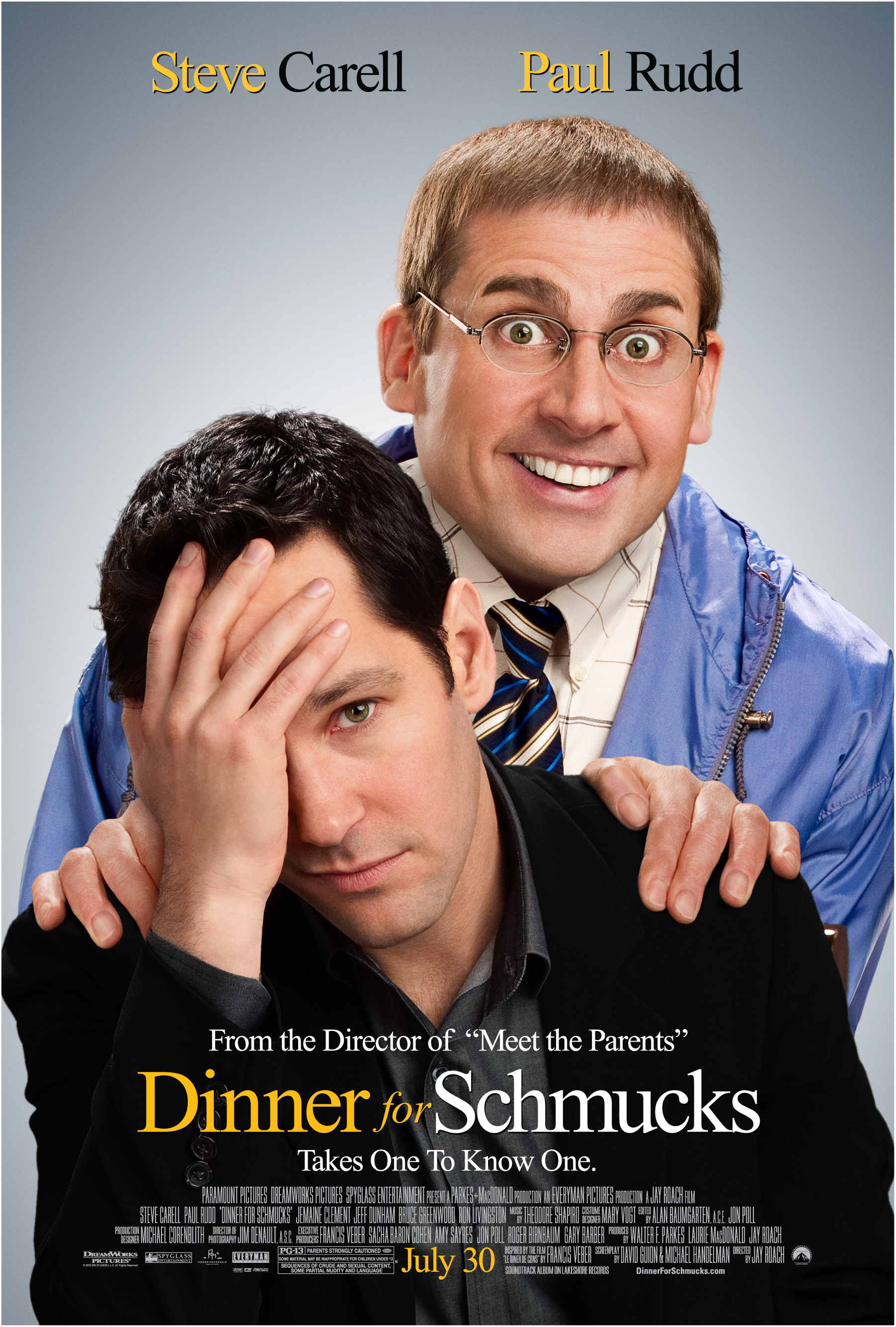
Movie Review 1 - Dinner for Schmucks

This month December, I will dedicate my blog posts to reviewing movies I missed before, that I'm catching up now, and I feel it's worth it to be reviewed. Maybe the movie has some good qualities, and is worth to watch. The first review will be Dinner for Schmucks. I know, I know, this movie has been ages but deep down I really feel like I need to watch it, and it seemed like I made the right choice.

Dinner for Schmucks is about how an employee was trying hard to impress his boss to get promoted, was in a dilemma when he was invited to a dinner where every guest should bring an "idiot" for them to make fun at. Tim (Paul Rudd) found Barry (Steve Carell) trying to save a dead mouse on the street, and texting while driving, Tim bumped into Barry with his car but he was lucky that Barry was safe and an idiot enough to think the latter was the one who should pay for any damage caused by the accident.

Barry's presence in Tim's life had been collateral. Barry did not just bring back a violent stalker of Tim's three years back, but he also caused Tim's girlfriend to leave him, his house to be in a huge mess, and his car to be so massively damaged by the psychotic stalker. Barry also almost put Tim's career in jeopardy but being a good friend, Barry attempted to get Tim his promotion by attending the dinner (while Barry did not know at all that the dinner was for "schmucks"). Tim, finally following his conscience, standing up to Barry and lost his job.


Something intriguing that I observed while watching this movie. You see, this movie teaches about dreaming and daring to dream. Do you notice that successful people are people who dare to dream and who dare to actually step forward in achieving their dreams? They do stop sometimes and pause and think what might happen, but the difference between these people and stuck-at-life people is that, they don't turn back. Barry understood this, so that was why he tried so hard to make sure that nothing stopped Tim from achieving what he wanted, what he dreamt of.

Barry was excited and looking forward to the dinner, which was why too that he never let anything to stop him from going. Although he learnt how Tim actually felt about him, that he was an idiot and friendless, Barry still went to the dinner to see people (although part of it too was that he hoped Barry got the promotion). This teaches us that, people will always try to put us down, and if we want to be successful, what they should not do good enough to make us stop. We should keep going, and going, and going.

Idiots do not think about consequences, which may be why they are more daring than us, but we have to know, it's their redeeming quality. And that is something we should learn from them. At the end of the movie, Barry finally fixed everything, his heart triumphed over his head when he knew if Tim's girlfriend knew what Tim felt about her, how madly in love he was with her, she'd be back to him, which was why Barry let Tim ranted about his feelings while she was at the back, listening.

And Barry said, the evolving monkey, the Wright brothers, Sir Francis Bacon, Vincent van Gogh, Louis Pasteur, Benjamin Franklin, Evo Kanevo, and his best-friend-to-be, Tim Comrad that they were dreamers and without their dreams, they couldn't even achieve what they did now.

Watch it. It's worth your money and time.

"You may say I'm a dreamer, but I'm not the only one..."